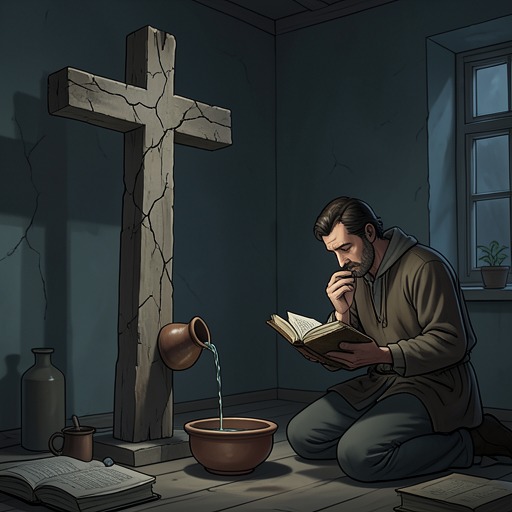
Eva Miller’s crucifix
'Salem's Lot: A NovelEva Miller’s crucifix is both a personal relic and a practical instrument of resistance against the vampire threat. Kept as the crucifix of Eva’s deceased husband, it carries emotional value before its supernatural usefulness becomes apparent. When Ben Mears takes it into the night to help Matt Burke, the object crosses from private memory into the dangerous public struggle consuming Jerusalem’s Lot.
Identity and Provenance
The crucifix belongs to Eva Miller and had belonged to her husband, who was Catholic. Eva keeps it in her bedroom, and her reluctance to lend it is not based on superstition alone: she explicitly tells Ben that it has “great value” for her. Its value is therefore double. It is a religious sign whose force depends on belief, but it is also a surviving possession tied to a marriage and to the absent man who once owned it.
The object is described materially rather than ceremonially. It is silver, carried on a fine-link chain, and catches the light with a dim reflection. That modest physical presence matters because the crucifix is not introduced as an exotic weapon. It is an ordinary household object, nearly invisible within the domestic life of Eva Miller’s boardinghouse, until the surrounding crisis reveals what it can do.
Entry into the Vampire Investigation
Ben obtains the crucifix after Matt Burke urgently asks whether he has a crucifix, a St Christopher’s medallion, or anything similar. Ben identifies himself as formerly Baptist and has no such object of his own. Eva supplies the missing religious protection, though she is puzzled because Matt is not Catholic and, as she understands it, does not attend church. Her confusion shows that the object’s immediate function is not explained by ordinary religious affiliation; it is being requested because the danger has exceeded ordinary categories.
When Ben takes the crucifix, he cannot comfortably manage it and his car keys at the same time, so he slips the chain over his neck. The silver rests against his shirt, and he becomes aware that it comforts him. This is the first change in the crucifix’s status: before it is tested against any visible monster, it alters Ben’s emotional condition. Fear remains, but the object gives that fear a shape and offers him a physical sign that he is not approaching the danger entirely unprotected.
At Matt Burke’s house, the hall light catches the cross against Ben’s chest, and Matt immediately notices that he has brought one. Ben then slips it over Matt’s neck as well. Matt admits that it makes him feel better, even joking that he might be allowed to wear it when authorities take him to Augusta. The humor does not cancel the terror; it is a pressure valve around the recognition that rational explanations are failing. The crucifix becomes a shared object, passing from Eva to Ben and then from Ben to Matt, binding three different responses to the crisis: Eva’s guarded attachment, Ben’s frightened resolve, and Matt’s attempt to remain intellectually composed.
Religious Sign and Supernatural Force
The crucifix’s power is presented as inseparable from the faith invested in it. Father Callahan’s earlier religious reflection preserves the principle that ritual action requires more than mechanical performance, while Jimmy Cody later asks Ben to bless a makeshift cross and tells him to make up the words if necessary. Together, these moments establish a contrast between fixed ecclesiastical authority and improvised belief under emergency conditions. The crucifix is valuable not merely because it is shaped as a Christian symbol, but because the people using it treat that symbol as an active force.
The object’s significance intensifies when Ben and the others confront the Marsten House. Father Callahan carries the crucifix to the entrance, where the house appears to exude its accumulated evil. He commands the spirits to depart in the name of God the Father and strikes the door with the cross. The response is violently physical: a flash of light, the pungent smell of ozone, a crackling sound, the explosion of the fanlight and bay window, and the welding of the new Yale lock into an unrecognizable mass. The crucifix thus operates at the boundary between symbol and instrument. It does not simply reassure the witnesses; in this encounter, it participates in changing the material environment.
That confrontation also clarifies the difference between possessing a holy object and acting through it. Father Callahan is not calmly performing a routine rite. He is seized by an eagerness he believed had disappeared, and he is impelled toward the door rather than merely choosing a cautious approach. The crucifix concentrates this renewed authority in a single gesture. Its force is revealed through a collaboration among faith, human action, and the hostile house itself, rather than through an abstract rule detached from circumstance.
Circulation, Memory, and Consequence
After Mike Ryerson’s death, Ben returns the crucifix to Eva’s sphere of domestic life, carrying it on its chain and showing it to her. Eva has heard about Mike and asks why Matt wanted Ralph Glick’s crucifix, apparently confusing the object with another religious item connected to the Glick family. Ben offers an ordinary explanation, saying that Matt may have thought Mike was Catholic. Eva rejects the premise by recalling that Matt taught Mike in school and that Mike’s family were Lutherans. The exchange places the crucifix within the town’s network of memory and gossip, where even a private object becomes entangled with the community’s effort to explain abnormal deaths.
The confusion is revealing because it shows how quickly religious objects circulate through the town’s emergencies. The crucifix is not isolated from funerals, bodies, graves, and questions about confession or burial. The story repeatedly places it beside scenes in which death refuses to remain final: Danny Glick’s opened coffin reveals a face with “hideous life,” while medical examination finds corpses without expected signs of rigor, and bodies are later stolen from the Cumberland County Morgue. Against this pattern of corrupted death, Eva’s crucifix offers a counter-image: an object retained across generations that carries continuity rather than contamination.
Its later appearances broaden that function. It is present when improvised religious protection is needed, when the group approaches the Marsten House, and when sealed resistance is turned into physical action. The locks of Barlow’s coffin eventually split when Ben and Mark Petrie touch them, extending the narrative’s pattern in which barriers, religious signs, and acts of faith become materially consequential. Eva’s crucifix is not the sole cause of the resistance, but it belongs to the network of objects and gestures through which the living attempt to stop the dead from ruling the town.
Narrative Significance
Eva Miller’s crucifix dramatizes the novel’s movement from ordinary domestic realism into supernatural conflict without abandoning the material world. It begins in a bedroom, attached to a dead husband and guarded by a woman who values it personally. It then appears around Ben’s neck, against Matt’s chest, and in Father Callahan’s hand at the Marsten House. Each transfer changes its meaning: keepsake, borrowed protection, shared reassurance, and weaponized sacrament.
The crucifix also makes belief visible. Matt is not presented as conventionally devout, and Ben has been separated from Baptist certainty, yet both accept the object’s protection when confronted with what cannot be handled by medicine, law, or ordinary courage. Eva’s insistence that the crucifix be treated carefully prevents it from becoming a disposable prop. Its power remains connected to ownership, memory, and reverence even as the crisis forces it into use.
In the larger structure of Jerusalem’s Lot’s collapse, the crucifix stands for a fragile but active continuity. The town’s darkness works through desecrated graves, altered bodies, stolen corpses, and a house saturated with evil; the crucifix answers through inheritance, ritual, touch, and chosen action. Its decisive importance lies in that contrast. It is a small object, but the narrative repeatedly makes small physical signs carry the burden of resisting forces that appear immeasurably larger.